

Two cancer survivors agree: Prop 38 is the wrong way to fund medical researchRead the op-ed Watch our first press conferenceFormer LAO analysts explain what’s wrong with Prop 38Watch video →

Proposition 38: Follow the money

A billionaire is pushing Prop 38.It steers $4.2 billion to one institution. His.And California taxpayers get the bill—for 20 years.

This billionaire-backed measure would require an estimated $500 million to $600 million in General Fund payments every year for roughly 20 years—putting more pressure on California’s already constrained budget.

Follow the money. Vote No.

Follow No on 38

Campaign news, videos and ways to help.

$4.2Bpositioned for one unnamed institution
$8.4Bin taxpayer-backed borrowing
20 yearsof estimated General Fund payments

A growing coalition

Trusted voices say No on Proposition 38.

About Proposition 38

Good science deserves better than Proposition 38.

Medical research matters. So do open competition, independent review and honest accounting for public money.

01Follow the $4.2 billion

A billionaire is pushing Proposition 38—which unfairly steers $4.2 billion to one institution. The one he helped create.

Proposition 38 appears written to direct approximately half its funding—about $4.2 billion—to a single UCLA-affiliated institution without naming that institution for voters.

California has many world-class universities, hospitals and independent research centers. No institution should be guaranteed billions of taxpayer dollars through eligibility requirements written into a ballot measure.

Public research funding should be awarded through open competition based on scientific merit—not predetermined by the measure’s sponsors.

Bottom line: Californians should not approve a ballot measure that conceals its largest beneficiary while effectively guaranteeing that beneficiary billions of dollars.
02The guaranteed bill

Proposition 38 would saddle taxpayers with decades of debt, consuming funds that could otherwise support the important services Californians rely on.

Proposition 38 would borrow $8.4 billion, requiring an estimated $500 million to $600 million in annual debt payments for roughly two decades. Those payments would come from California’s General Fund, where they would compete with health care, education, housing, public safety and other essential services.

Proponents suggest that royalties and other returns could help offset the cost. Californians have heard similar promises before, but speculative future revenue is not a responsible basis for taking on billions of dollars in public debt. Taxpayers remain responsible for the bond payments whether the research produces profitable treatments or not.

Bottom line: The benefits are uncertain, but the debt is guaranteed.

03The wrong way to fund science

Proposition 38 would lock California into fixed funding decisions—and could hinder the search for tomorrow’s cures.

Immunology and immunotherapy are important and promising fields. That is precisely why funding decisions should be made through rigorous peer review and open competition among California’s best scientists—not permanently fixed through a ballot initiative.

Science changes rapidly. The most promising approach today may be overtaken by a discovery in another field tomorrow. Proposition 38 would commit billions of dollars to one scientific area and concentrate half the funding in one institution for years to come. It cannot adapt as evidence, technology and public-health needs change.

California should invest in biomedical research, but it should fund the strongest proposals wherever they originate—not place billions of taxpayer dollars in one institutional and scientific basket.

Bottom line: Let scientists compete to fund the best science. Don’t lock research decisions into the ballot box.

One more question

Why less sunlight for billions in public money?

Despite promises of accountability, the selected institute would not be treated as a public agency under key California transparency and ethics laws, including the Public Records Act, open-meeting requirements and the Political Reform Act.

Public money should come with full public accountability.

Straight answers

Support Research. Fund it wisely and transparently.

Does voting No mean opposing medical research?

No. We support biomedical research, including immunology. We oppose a measure that appears to preselect one institution, limits California’s ability to adapt scientific priorities and finances the program with decades of General Fund debt.

Who is positioned to receive the $4.2 billion?

The measure does not name the institution. CalMatters reported that its eligibility criteria very likely point to the California Institute for Immunology and Immunotherapy, whose co-founder and board chair is the largest financial backer of Proposition 38.

What if royalties pay back the bond?

That is possible, but not guaranteed. The Legislative Analyst says the amount and timing of revenue are uncertain and that offsetting the bond cost could take decades. California’s principal and interest payments would still be legally due.

What should California do instead?

Use independent scientific review and open competition to fund the strongest proposals across institutions and fields. Research priorities should be able to change as evidence, technology and public-health needs evolve.

CBS Sacramento video report

CBS takes a closer look at Proposition 38.

Dr. Robert Kaplan, co-chair of No on Proposition 38 and a former associate director of the National Institutes of Health, explains why Proposition 38 is the wrong way to support medical research.

CBS Sacramento · Video report
CBS News SacramentoProposition 38
Dr. Robert M. KaplanCo-chair · No on Proposition 38
Former NIH associate directorSenior scholar · Stanford School of Medicine

CBS News Sacramento presents a closer look at the arguments over California's Proposition 38. Watch the original report at CBS News ↗

Featured interview excerpt

A closer look at Proposition 38.

California Policy Center CEO Will Swaim discusses Proposition 38 during California Insider’s review of the 2026 statewide ballot.

Interview excerpt · 3:14
California InsiderAugust 19, 2026
Siyamak KhorramiHost
Will SwaimGuest · CEO, California Policy Center

Excerpt runs from 28:41 to 31:55. Video courtesy of California Insider. Open the excerpt on YouTube ↗

Newsroom / Press

Reporting and campaign resources.

Independent reporting and materials for journalists, voters and organizations following Proposition 38.

San Diego Union-Tribune · Editorial endorsement · September 18, 2026

“An $8.4 billion wolf in sheep’s clothing”

The San Diego Union-Tribune endorses a No vote on Proposition 38. Read the editorial board’s case against the measure.

Read the endorsement

San Francisco Chronicle Open Forum · September 12, 2026

Two cancer survivors agree: Prop 38 is the wrong way to fund medical research.

“The debt is guaranteed. The discoveries and royalties are not.”

A conservative and a Democrat explain why their personal commitment to finding better cancer treatments leads them to oppose Proposition 38’s unfair financing scheme.

Read the op-ed

The Sacramento Bee · September 11, 2026

Retired analysts raise transparency concerns over Prop 38.

The Bee reports on concerns raised by former Legislative Analyst’s Office experts about Proposition 38’s funding structure, accountability provisions and apparent benefit to one institution.

Supporting scientific research does not require supporting Proposition 38.Judy Heiman’s takeaway

Read the Sacramento Bee story
Watch the press conference

Campaign video · September 10, 2026

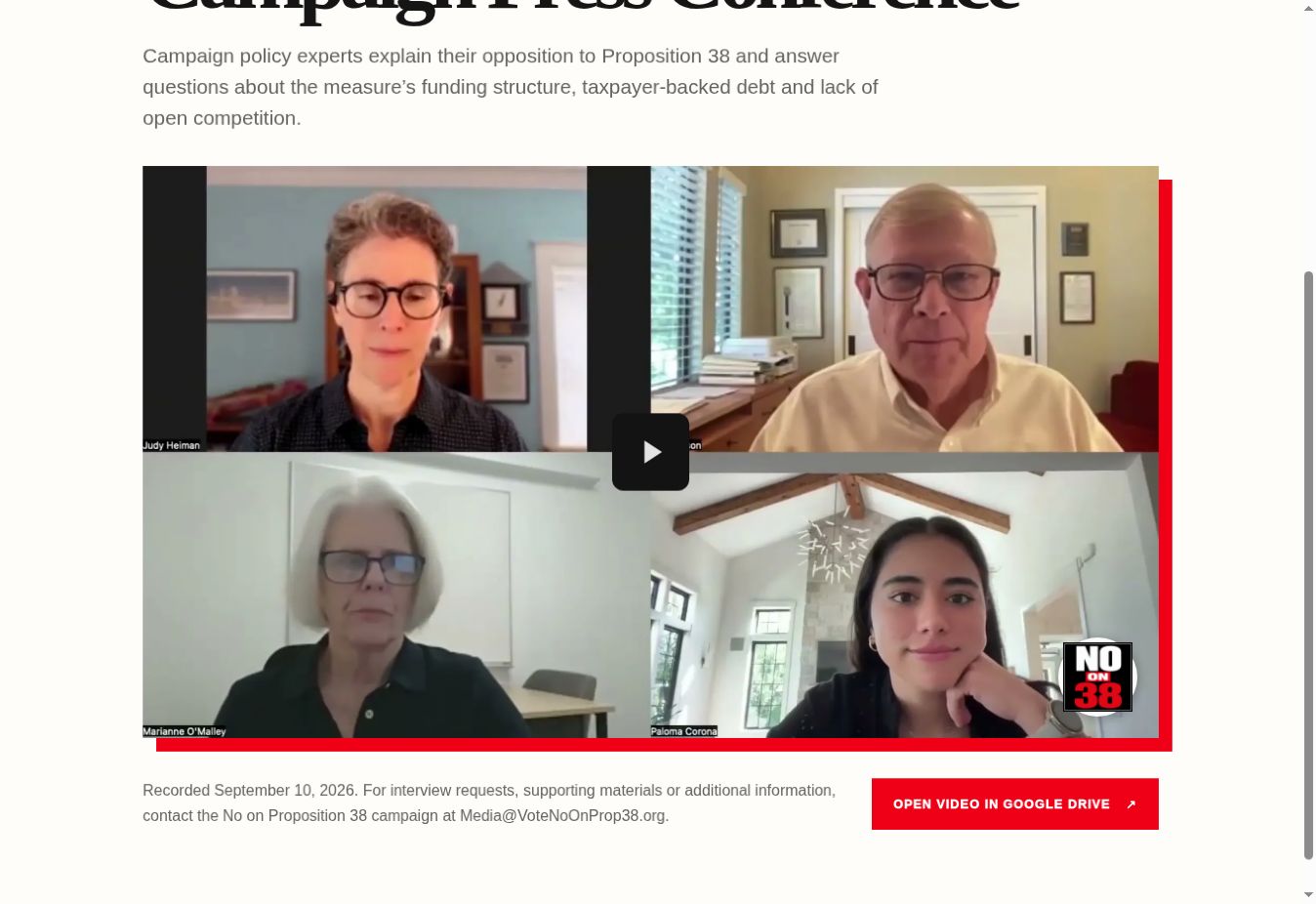
Press conference with former LAO analysts.

Campaign policy experts explain their opposition to Proposition 38 and answer questions about the measure’s funding structure, public debt and lack of open competition.

Watch the press conference

CalMatters · July 31, 2026 · Updated August 3, 2026

This CA proposition will send $4 billion to a single nonprofit. Who’s behind it?

CalMatters examines Proposition 38’s eligibility requirements and reports that they very likely point to a single UCLA-affiliated institute—without naming it for voters in the measure.

Read the CalMatters reporting

Science · Independent reporting

California to vote on spending $16 billion to boost research after Trump cuts

Science examines Proposition 38’s unusual funding structure and reports on concerns raised by Dr. Robert Kaplan and David Panush about directing half the bond money to a single institution outside a competitive, peer-reviewed process.

“There is a strong case for investing more in biomedical research, but Proposition 38 is not the right way to do it.”—Dr. Robert Kaplan

Read the Science article
KCRA 3 video report about Proposition 38Watch the KCRA 3 report

KCRA 3 · Video report · August 30, 2026

California voters weigh the promises—and the price—of Proposition 38.

KCRA presents both sides of the measure and explains that roughly $4 billion would go to one unnamed institute, while taxpayers would repay an estimated $12.5 billion from the General Fund. Any research revenue that might offset those costs is not guaranteed.

“Bonds sound really good. They sound like free money, but they’re not free money.”—Susan Shelley, Howard Jarvis Taxpayers Association

Watch at KCRA 3

Ballot recommendation · League of Women Voters of California

League of Women Voters of California recommends No on Proposition 38.

The League says the measure would commit taxpayers to decades of debt while restricting California’s future research choices.

Read the League’s analysis

Editorial endorsement · Orange County Register · August 23, 2026

Orange County Register endorses No on Proposition 38.

Calls Prop 38 “an $8.4 billion money grab.”

Read the endorsement

Campaign statement · Open letter

An Open Letter to Prop 38 Proponents

No on Proposition 38 asks the measure’s proponents to explain why more than $4 billion appears reserved for a single institution—and why ordinary safeguards of competition, peer review and full public transparency do not appear to apply.

Read the open letter

Press Release #1 · August 3, 2026 · PDF

CalMatters investigation reveals Prop 38 would steer $4.2 billion to its top donor’s institution

The No on Proposition 38 campaign responds to the investigation and calls for open competition, full transparency and honest accounting for billions in taxpayer-backed debt.

Read Press Release #1

Campaign fact sheet · September 12, 2026

Prop 38 Says It Will Pay for Itself. California Has Heard That Before.

California’s stem-cell bonds show why promised research royalties should not be confused with guaranteed repayment of billions in public debt.

Read the fact sheet
No on 38

Open competition. Honest accounting.

Vote No on Proposition 38.

Help us protect California taxpayers and keep medical research competitive, accountable and guided by science.

Follow the campaign

Contributions to this committee are not tax deductible.