
Endorsement: Prop 38 is one of the most noxious deposits on California’s political dung heap in years

In a California election filled with compromised candidates and mind-numbing tax measures, wouldn’t it feel great to vote for something everyone can agree will make a positive difference in the world?
Proposition 38 on the November ballot positions itself as such a balm.
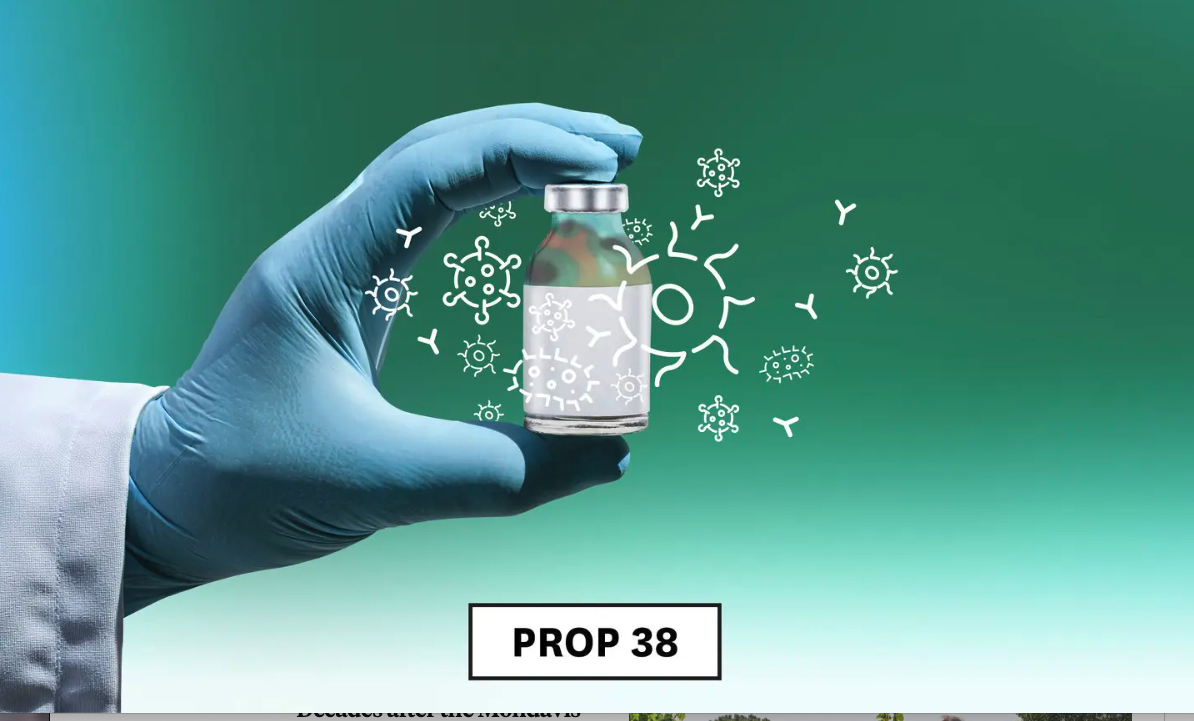
It would authorize the state to issue $8.4 billion in bonds for medical research into immunology and immunotherapy to identify treatments and cures for cancer, Alzheimer’s and heart disease. If any drugs receive commercial approval, California patients would get a 20% discount off the national average price, and 10% of revenue would go to state coffers.
Who doesn’t want to cure cancer and save the state’s budget in the process?
But Prop 38 is no balm; it’s one of the most noxious deposits on California’s political dung heap in years.
The measure requires the California Department of Public Health to give half the bond money — $4.2 billion — to an unnamed nonprofit medical research institute that meets a long and unusual list of criteria, including occupying a minimum 200,000-square-foot space and receiving a $50 million donation for a “microbiome research program.”
These requirements have no bearing on an institution’s ability to conduct high-quality, cutting-edge immunology research. Instead, they’re written so that a lone research center is eligible to receive the lion’s share of taxpayer money: the California Institute for Immunology & Immunotherapy.
California has many established and well-regarded research institutes — including some that have made significant advances in these fields.
But the California Institute for Immunology & Immunotherapy is not among them.
Instead, it’s a brand-new institute, and its founders include the same billionaires who paid to put Prop 38 on the ballot: Surgeon Gary Michelson, businessman Meyer Luskin and financier Michael Milken, who, in addition to his longtime financing of medical research, is also known as the “junk bond king.” He was pardoned by President Donald Trump in 2020 for his 1990 guilty plea to racketeering and securities fraud.
In an endorsement interview, Yes on 38 campaign spokesperson Robin Swanson insisted to us that the institute is “well positioned” to put $4.2 billion to good use, touting initial philanthropic contributions of $250 million and its affiliation with UCLA and its medical center.
But the California Institute for Immunology & Immunotherapy literally has no track record of developing, funding or bringing medical research to market. It isn’t even fully built. Despite already receiving $200 million in taxpayer funds in California’s 2022-2023 budget, construction on a “majority” of the space isn’t expected to be completed until 2028, a spokesperson acknowledged via email.
Key leadership positions remain empty. As of this writing, the institute is still searching for a director, the spokesperson said.
It doesn’t even have a public strategic plan. When we pressed for details, the spokesperson would only say, “While CIII continues to refine its longer-term business plan, several core elements are complete or well underway.”
The spokesperson insisted that the institute wasn’t involved in drafting Prop 38 and isn’t part of the campaign. But, again, its billionaire co-founders put the measure on the ballot and have raised more than $38 million to support it.
The institute may be playing coy about how it will benefit from Prop 38, but campaign proponents make no secret of where the money will end up.
“CIII is ready to go,” Swanson said, against all evidence.
Swanson and other Prop 38 supporters leaned heavily on the UCLA affiliation to assuage concerns over the institute’s glaring shortcomings.
UCLA is indeed a top research university. But what exactly is the “affiliation” here?
The institute is leasing space at a new UCLA Research Park but will mostly operate independently from the university. An institute spokesperson said the “formal affiliation agreement” defines their “relationship and responsibilities,” including mission and purpose, facilities, funding, intellectual property, personnel and governance. Some senior UCLA leaders sit on the institute’s board of directors, including Chancellor Julio Frenk, and UCLA “reserves the right to veto actions that it deems will result in reputational harm or contravene the university’s mission,” Phil Hampton, senior director of communications for UCLA Health and the David Geffen School of Medicine, said in an email.
These vague answers do not assuage our serious doubts about the institute’s ability to manage billions in taxpayer funds.
Indeed, the measure also grants the institute “primary responsibility” for negotiating sale and licensing agreements for all drugs developed through Prop 38-funded research — even therapies created by other universities or nonprofit institutions, which would have to compete for the remaining $4.2 billion in bond money.
Funding decisions would be made by a council of representatives from seven of the 10 University of California campuses — Berkeley, Davis, Irvine, Los Angeles, Riverside, San Diego and San Francisco — and 10 to 15 other universities and nonprofit research institutions.
But there are red flags here, as well.
The money is reserved for projects at the institutions represented on the council — raising serious conflict-of-interest concerns. Proponents said council members would have to abide by ethics and conflict-of-interest regulations — although the measure carves out multiple exceptions — and the council and institute would be subject to independent audits and annual reporting requirements.
Supporters ask voters to look past these issues by arguing that state-level investment is needed because of President Donald Trump’s funding cuts for medical research. But National Institutes of Health funding for immunotherapy research has steadily risen since 2019, when it was established as a new category.
Moreover, Robert Kaplan, an opponent of the measure who was an associate director at the National Institutes of Health and formerly led UCLA’s health services program, told us that Prop 38 fundamentally misunderstands how funding top-tier medical research works.
It doesn’t make sense to restrict billions of dollars to just one area of research, Kaplan said. After all, there’s no guarantee that immunology, as opposed to another field of study, holds the cure to cancer or Alzheimer’s. Funding should be prioritized for thoroughly vetted projects that show the greatest promise of making a difference. Limiting the eligibility pool will almost certainly waste money on efforts that lack merit or scientific rigor.
That’s a lesson Californians should be familiar with.
In 2004, voters approved $3 billion in bonds for stem-cell research, swayed by the promise of miracle cures and huge financial windfalls for the state. Those didn’t materialize, a Chronicle investigation found; in fact, the measure may have actually empowered an uptick in clinics peddling pseudoscience.
That didn’t stop voters from approving yet another measure in 2020 authorizing $5.5 billion in bonds for stem-cell research.
Let’s not make the same mistake a third time.
There isn’t a family in California who hasn’t been touched by cancer, Alzheimer’s or heart disease. Better treatments and cures cannot come fast enough. We applaud any billionaire who earnestly wants to harness their fortune to fight disease. But if Michelson, Luskin and Milken want Californians to believe that’s their intention with Prop 38, they should spend their own money and come back to taxpayers when their institute actually has some progress to show.