
Opinion: Prop. 38 is a business scheme disguised as a public health plan. Vote ‘no.’

For over sixty years, we have been fighting for progressive budgets that make a difference for people who are struggling to get adequate health care, food, housing, childcare and the basic services that maintain human dignity. This year there’s a new threat to California’s ability to provide these life-supporting basic goods — it is on the November ballot for the voters to decide.
The issue is Proposition 38. It directs the state to borrow $8.4 billion for immunology research. We support medical research to cure disease. But Prop. 38 is the wrong way to do it: it’s deceptive policy, bad science and dangerous to our ability to meet other important community needs.
Here’s why:
This isn’t a ballot measure — it’s a business plan disguised as one.
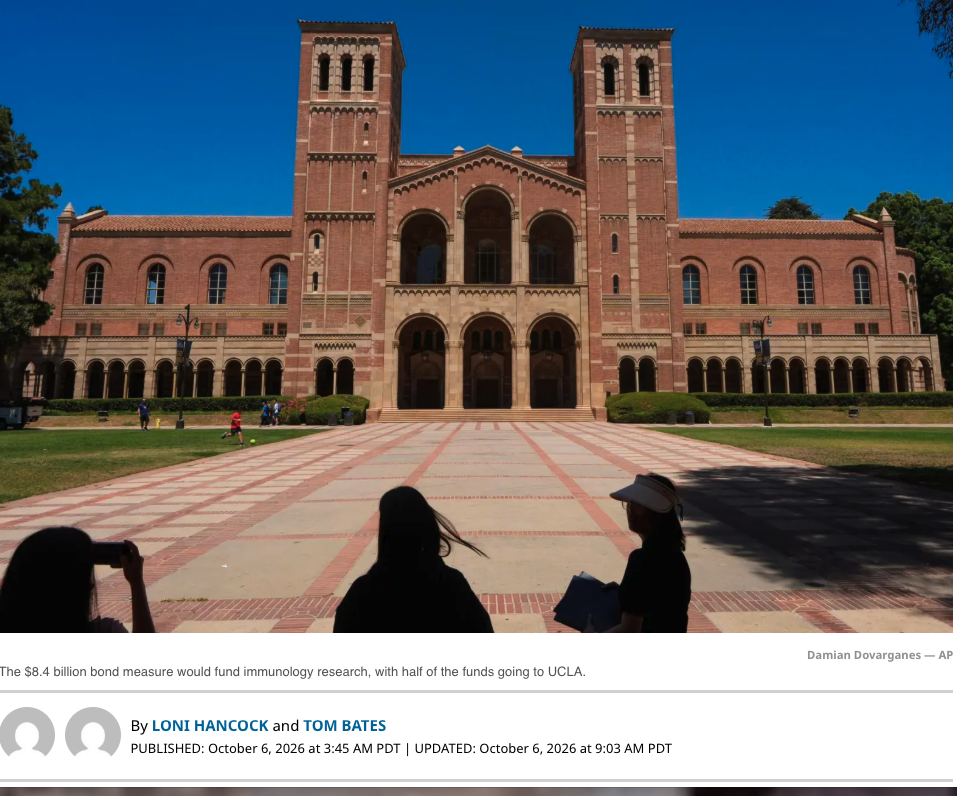
Two billionaire co-founders of the California Institute for Immunology and Immunotherapy (a UCLA-affiliated institute) wrote Prop. 38 and then wrote that half the money — $4.2 billion dollars — is earmarked for their own institute. CalMatters dug into the fine print and found eligibility criteria so narrow that, as a practical matter, only one applicant can qualify. That’s not how medical research funding is supposed to work. Normally, grants go through open competition and independent peer review, evaluated on the merits — not handed out because a handful of wealthy donors used the initiative process to pick the winner in advance.
Borrowing $8.4 billion dollars is the most expensive possible way to pay for any research. Because it’s a bond, taxpayers are on the hook for 20 years of repayment — more than $500 million dollars a year — money that comes directly out of the General Fund, meaning less for health care, higher education, childcare and the rest of our community needs. This is coming at the exact moment when federal cuts are putting California families at risk.
We’ve tried this before: California’s 2004 stem-cell bond cost taxpayers an estimated $6 billion. Twenty-two years later, total royalties returned $16 million — less than 1%. Prop. 38’s backers claim “up to 10% of profits from any discoveries will go to state government.” But the royalty formula doesn’t turn a projection into a promise, and voters shouldn’t be asked to bank on this bond “paying for itself” sometime in the future. Our needs are now!
This research institute is built to answer to no one. It would sit outside the Public Records Act and California’s open-meeting laws — the tools voters rely on to see how public money is spent. Its leaders are exempted from the Political Reform Act, meaning no Statement of Economic Interests, no disclosure of outside financial ties, none of the conflict-of-interest safeguards every other public official has to meet. A program spending your tax dollars shouldn’t get to operate behind a closed door.
Betting $8.4 billion on one scientific hypothesis is reckless, no matter how promising it looks today. Immunology may well produce breakthroughs — but locking in decades of exclusive funding forecloses the state’s ability to follow the evidence wherever it actually leads. Science doesn’t announce its winners in advance, and public money shouldn’t be committed as if it does.
Disease doesn’t respect state borders, and neither should the responsibility for curing it — this is fundamentally a national undertaking, and the right fight is to restore the federal research funding this administration has cut, not to have California go it alone at ruinous cost.